Abdominal Anatomy: More Than Just a Six-Pack
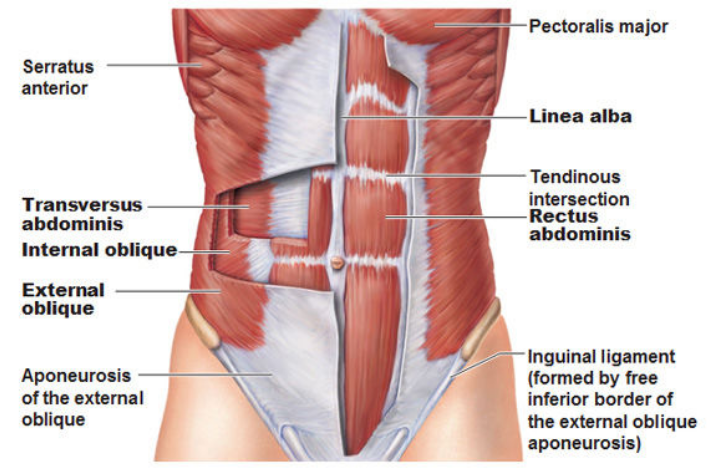
Your abdomen plays a vital role in connecting your upper body to your pelvis. It helps protect your internal organs, generates intra-abdominal pressure, and supports spinal movement and stability. Rather than being a single muscle group, the abdomen is made up of four paired muscles that work together as a system:
External Obliques
These muscles originate on the lower eight ribs and attach to the midline of the abdomen (linea alba), pubic crest, and iliac crest. They assist with trunk rotation and side-bending.Internal Obliques
Located beneath the external obliques, these muscles originate from the iliac crest, inguinal ligament, and lumbar fascia. Their fibers run perpendicular to the external obliques and attach to the lower ribs, linea alba, and pubic crest. Together, the obliques help rotate and side-bend the spine.Transversus Abdominis (TrA)
Often referred to as the “deep core,” the TrA wraps horizontally around the abdomen like a corset. It originates from ribs 5–10, the lumbar fascia, iliac crest, and inguinal ligament. When activated, it compresses the abdominal contents and provides deep spinal and pelvic stability.Rectus Abdominis
This is the muscle most people think of when they hear “abs.” It runs from the pubic bone up to the sternum and ribs 5–7. Its primary function is trunk flexion—think sit-ups.
Why Core Strength Matters
Core strengthening is a cornerstone of physical therapy and is commonly prescribed for:
Diastasis rectus abdominis (DRA), often seen during and after pregnancy
Low back pain or recovery from spine surgery
Hip pain or post-hip surgery rehabilitation
Recovery following hernia repair
A well-coordinated core supports movement, reduces strain, and helps your body move more efficiently.
The Relationship Between Your Abdominals & Pelvic Floor (Your 360° Core)
Your abdominals and pelvic floor do not work in isolation—they are part of an integrated system often referred to as the 360° core. This system provides support all the way around your trunk, not just in the front.
The diaphragm forms the top
The pelvic floor forms the bottom
The abdominals and deep spinal muscles wrap around the front, sides, and back
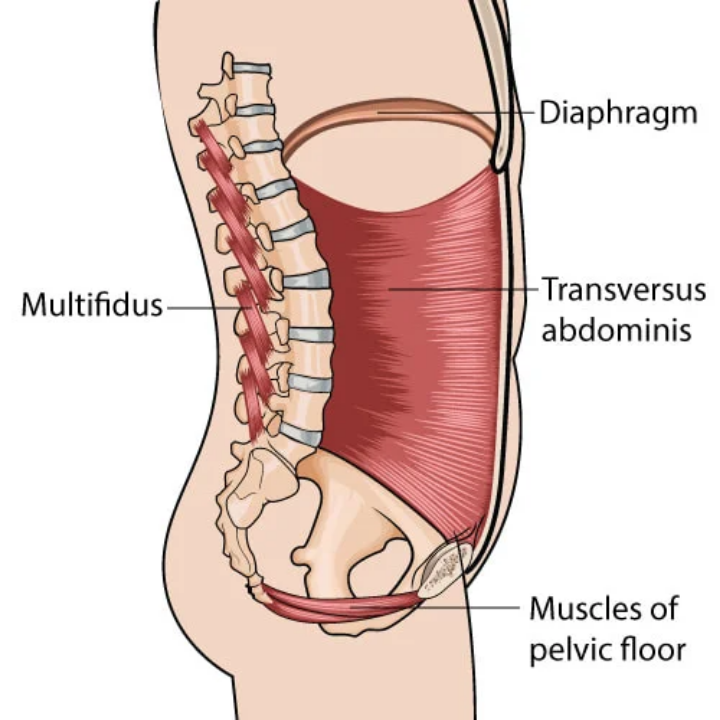
When the 360° core is working well, these muscles coordinate together to manage pressure, support your spine, and stabilize your pelvis during movement.
With everyday activities like lifting, running, coughing, or exercising, your pelvic floor and deep abdominals should respond together—not grip, bear down, or shut off. Breathing plays a huge role in this coordination, allowing pressure to be distributed evenly throughout the system.
During pregnancy and postpartum, changes in posture, breathing mechanics, and abdominal length can disrupt how the 360° core functions. This may show up as leaking, pelvic pressure, back pain, or difficulty reconnecting with your core.
This is why we focus so much on breath-driven, deep core activation—to restore coordination, improve support, and help your body move with confidence again.
What Research Tells Us About DRA & Core Activation
Research shows that the transversus abdominis and pelvic floor muscles naturally co-activate in young, asymptomatic women. However, this coordination changes during pregnancy and postpartum—regardless of delivery type.
Some key findings:
DRA affects 66–100% of women in late pregnancy and up to 53% immediately postpartum.
Natural healing occurs most rapidly in the first 8 weeks postpartum, after which progress may plateau—though improvement can continue up to a year postpartum.
About 36% of women still have DRA at 12 months postpartum.
Studies suggest that rectus abdominis exercises early postpartum may reduce the inter-recti distance more effectively than TrA-only exercises.
DRA is assessed by measuring the inter-recti distance (IRD), with ultrasound being one of the most reliable tools. While no universal diagnostic cutoff exists, an IRD of approximately 2.2–2.3 cm at the umbilicus is often considered clinically meaningful.
This is why individualized assessment and exercise prescription matter.
Breath + Deep Core Activation: A Foundational Exercise
I’m currently 4 months postpartum, and one of my staple exercises is transversus abdominis and pelvic floor activation with breath—also known as deep core retraining.
I love this exercise early postpartum to reconnect with the core and restore coordination. Now, I also use it before lifting or running to prime my core for movement.
Because our bodies love to compensate, cueing matters. Watch this video on my instagram feed and follow along with these tips below:
On a gentle exhale, try this:
Gently draw your belly button toward your spine, imagining a string pulling it down toward the ground
Scoop the lower belly and gently flatten the space between your hip bones
Let your ribs soften and drop as you exhale
Lift the pelvic floor gently up and inward
Softly make a “shhhhh” sound
Avoid these common mistakes:
Forceful exhaling, sucking in hard, or holding your breath
Flexing your spine or aggressively tucking your pelvis
Squeezing your glutes or inner thighs
Overthinking it—this should feel subtle and controlled
From Coordination to Strength
In my practice, we always start with learning how to activate the deep core first, then gradually layer in intensity. Many people can perform high-level core exercises like V-ups or flutter kicks, but still lack proper coordination.
I often see doming through the midline, excessive spinal movement, or breath-holding to complete challenging exercises. A strong core is supportive, responsive, and adaptable.
I encourage you to take ego out of the equation and focus on quality activation first. A truly strong core is supportive, responsive, and coordinated—not just visibly strong.
One Last (Very Important) Reminder
Please avoid over-gripping your abdominals—holding your belly tight all the time. We need balance: softness at rest and support when needed. Releasing unnecessary tension allows your core and pelvic floor to respond more effectively when it matters most.
